
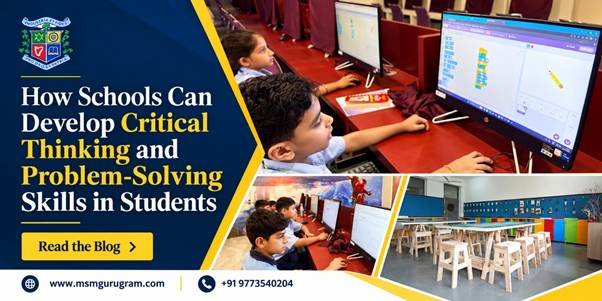
Education today is not only about remembering facts and scoring well in examinations. Critical thinking skills for students are becoming increasingly important because children need to understand information, question ideas, make sensible decisions and apply what they learn in real situations. A school that encourages students to think rather than simply memorise can help them become more confident, curious and independent learners.
For Indian parents, this is particularly relevant in a changing academic and professional environment. The ability to solve an unfamiliar problem or look at a situation from different perspectives can be just as valuable as knowing the correct answer to a textbook question.
The Shift From “What” to “Why”
Traditional classroom learning often focuses on finding the correct answer. While factual knowledge is important, children should also be encouraged to ask:
- Why does this happen?
- How do we know this is correct?
- Is there another way to solve it?
- What would happen if we changed one part?
- Can I explain my answer?
These simple questions can change the way children approach learning.
Instead of simply memorising a science concept, for example, a teacher can ask students to predict what might happen during an experiment and explain their reasoning. This encourages children to observe, connect information and form their own conclusions.
Why Problem-Solving Starts Early
Children encounter small problems every day. They may need to decide how to complete a group project, work out why an experiment did not produce the expected result or find a better way to organise their time.
These situations can become valuable learning opportunities.
Problem-solving skills in children develop when they are given the freedom to try different approaches, make mistakes and learn from the outcome. Teachers don’t always need to provide the solution immediately. Sometimes, asking the right question can help a child discover the answer independently.
For example, instead of telling a student exactly where they went wrong in a mathematics problem, a teacher might ask, “Which step would you like to check again?” This encourages the child to review their own thinking.
Learning Through Questions
One effective way of developing independent thinking is through inquiry-based learning.
In this approach, students are encouraged to explore a topic by asking questions, investigating information and drawing conclusions. The teacher acts more like a guide than someone who simply provides every answer.
Imagine a class discussing water conservation. Instead of only reading about water wastage, students could investigate how much water is used in their school, identify areas where it may be wasted and suggest practical solutions.
The students are learning the subject while also practising observation, research, analysis and decision-making.
Give Students Problems Worth Solving
Sometimes, the best learning activity is a problem without an immediate answer.
Schools can introduce practical challenges such as:
Challenge 1: How can we reduce plastic waste in our classroom?
Challenge 2: How can we design a simple structure using limited materials?
Challenge 3: How can we plan a school event within a fixed budget?
Challenge 4: How can we improve the layout of our classroom?
These problem-solving activities for students can encourage them to brainstorm, compare ideas, test possibilities and explain why they selected a particular solution.
The process becomes more important than simply arriving at one “perfect” answer.
Let Students Make Mistakes
One of the biggest barriers to critical thinking is the fear of being wrong.
If students feel that every mistake will be criticised, they may stop asking questions or sharing their ideas. A supportive classroom allows children to understand that mistakes are a natural part of learning.
Teachers can ask students to explain their reasoning even when their answer is incorrect. This helps identify where their thinking changed direction and gives them an opportunity to improve it.
Over time, children can become more comfortable saying, “I don’t know yet, but I can find out.”
That is a powerful learning mindset.
Group Work Can Strengthen Thinking
Critical thinking does not always happen individually. Group discussions can expose students to different opinions and approaches.
When children work together, they learn to explain their ideas, listen to others and decide which suggestions are most practical. They may also discover that the same problem can have several possible solutions.
Teachers can make group work more meaningful by giving each student a role and asking the group to explain the reasoning behind its final decision.
This develops communication along with analytical thinking.
Connecting Classroom Learning With Real Life
Students understand concepts better when they can see how those concepts apply outside their textbooks.
Mathematics can be connected to budgeting and shopping. Science can be linked to environmental concerns. Geography can involve understanding local transport or weather patterns. Language lessons can include debates, presentations and creative writing.
At Mount St. Mary’s Gurugram, the focus on developing students beyond rote learning can support an environment where curiosity, collaboration, practical understanding and independent thinking have a meaningful place in education.
How Parents Can Continue the Learning at Home
Critical thinking does not have to stop when school ends. Parents can encourage it through everyday conversations.
Instead of immediately answering every question, ask your child what they think first. When watching a news story or reading a storybook together, discuss different possibilities and ask why a particular character made a decision.
Even simple household situations can become learning opportunities.
For instance, while planning a family outing, ask children to compare travel options, consider time and cost, and explain which option they would choose.
These small conversations can help children become more comfortable with reasoning and decision-making.
Preparing Students for an Uncertain Future
The future will continue to change, and students may eventually work in roles that are very different from those that exist today. Memorised information alone cannot prepare them for every new situation.
They will need to ask meaningful questions, evaluate information, adapt to change, collaborate with others and find solutions when there is no obvious answer.
That is why schools should make thinking an everyday part of education rather than treating it as a separate skill. When students are encouraged to question, investigate, discuss, experiment and reflect, they gradually become more independent learners.
A classroom that gives children the freedom to ask “why”, explore different possibilities and learn from mistakes prepares them for much more than examinations. By combining thoughtful teaching with practical experiences, discussions and problem-solving activities for students, schools can help young learners develop the confidence and reasoning abilities they need for academics, everyday decisions and future careers.
For admission enquiries, contact 9773540204.
Frequently Asked Questions
1. What is critical thinking in education?
Critical thinking in education means helping students analyse information, ask questions, evaluate ideas and make decisions based on reasoning rather than simply accepting information at face value.
2. Why are critical thinking skills important for students?
They help students approach unfamiliar situations, understand concepts more deeply, evaluate information and make thoughtful decisions. These abilities can be useful both inside and outside the classroom.
3. How can schools develop problem-solving skills?
Schools can provide practical challenges, group projects, experiments, discussions and real-world situations where students need to identify a problem, explore possible solutions and explain their decisions.
4. How does inquiry-based learning develop critical thinking?
It encourages students to ask questions, investigate topics, collect information and reach their own conclusions. This makes students active participants in the learning process.
5. How can teachers encourage students to think independently?
Teachers can ask open-ended questions, allow students to explain their reasoning, encourage different approaches and create a classroom environment where making mistakes is treated as part of learning.