

Introduction
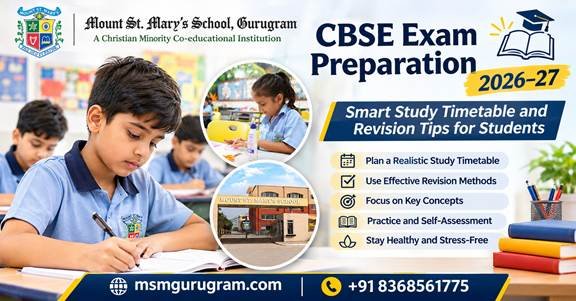
The 2026–27 academic year is an opportunity for students to build consistent revision habits rather than rely on last-minute preparation. Whether your child is preparing for a school examination or a board-level assessment, a smart timetable should balance subject coverage, practice, rest and feedback. This guide provides a flexible planning framework—not an official CBSE timetable or a promise of particular results.
First, confirm the correct examination schedule
Students should rely on their own school’s circulars for internal assessments and on official CBSE announcements for applicable board examinations. Class-level exam dates, syllabus coverage and assessment formats can differ. Do not use a generic online timetable as evidence of the exact date of your child’s examination.
Step 1: Map subjects and syllabus
Write down each subject, chapter, examination date if confirmed, and the student’s confidence level. Mark chapters as ‘not started’, ‘learning’, ‘needs practice’ or ‘ready to review’. This turns a large syllabus into a set of visible tasks. Ask teachers to clarify syllabus changes or unclear requirements.
Step 2: Prioritise without ignoring strong subjects
Give additional practice time to difficult topics, but schedule periodic review for familiar ones. A useful weekly plan includes new learning, retrieval practice and revision. Avoid spending every day on a single weak subject; switching tasks thoughtfully can help keep the overall syllabus moving.
Step 3: Build a realistic weekly timetable
A timetable should reflect school hours, homework, travel, sports and family commitments. For example, an older student might use one focused session for a difficult subject and another for practice or revision, with breaks between. Younger students usually need shorter sessions and more adult guidance. Keep at least one flexible slot for unexpected schoolwork.
Sample five-day revision plan
Monday: mathematics concepts and practice. Tuesday: science explanations and diagrams. Wednesday: language reading, writing and grammar. Thursday: social science concepts, maps or short answers as relevant. Friday: mixed recall and correction of mistakes. Use the weekend for a manageable review, unfinished tasks and rest. This is an illustrative plan; customise subjects and durations.
Step 4: Use a three-pass revision method
Pass one: understand and summarise the chapter. Pass two: recall the key ideas without looking at notes and attempt questions. Pass three: review mistakes and revisit weak areas after a gap. Students can use flashcards, concept maps, short self-quizzes or an error notebook depending on the subject.
Step 5: Practise the right kind of questions
Use school-recommended material, prescribed textbooks and official sample papers where applicable. Timed practice can be helpful for older students after they understand the content. Review accuracy, reasoning, presentation and time use rather than simply counting completed papers. Verify that any sample paper matches the relevant class and examination year.
Step 6: Plan the final seven days carefully
In the final week, focus on high-value review: definitions, formulas, diagrams, writing formats and previously missed questions as relevant. Avoid introducing large new resources unless a teacher recommends them. Prepare stationery and necessary materials early, confirm examination instructions and maintain regular sleep.
Step 7: Review progress each weekend
Ask three questions: What can I now explain confidently? What mistakes keep recurring? What needs help from a teacher? Update the next week’s timetable accordingly. The goal is steady improvement, not completing a perfect plan on paper.
Healthy revision habits matter
Students need adequate sleep, hydration, food, movement and time away from screens. Parents should watch for excessive stress, irritability or sleep disruption and respond with support rather than added pressure. A balanced schedule is more sustainable than an unrealistic target of studying every free hour.
Digital tools and AI: use with care
Digital flashcards, timers and learning tools can help organise revision. AI tools may offer explanations or practice prompts, but students should verify answers against school-approved materials and teacher guidance. Avoid sharing personal details or confidential schoolwork unnecessarily. AI should support understanding, not replace independent thinking or original work.
For parents: make the timetable a partnership
Discuss the schedule with your child and adjust it when schoolwork or family responsibilities change. Encourage questions and help them seek teacher support. Avoid measuring every day by marks alone. A timetable works best when the student understands it and feels able to follow it.
Explore learning at Mount St. Mary’s School, Gurugram
Mount St. Mary’s School shares information about its curriculum and school activities through its official website. Families who want details about assessment practices, class-wise academic planning or admissions should consult the school directly rather than assuming this general study guide is an official school examination circular.
Frequently Asked Questions
Is this the official CBSE 2026–27 exam timetable?
No. This article provides a sample study plan. Check official CBSE and school notices for examination dates.
How many hours should a student study daily?
There is no universal number. The plan should reflect age, syllabus, schoolwork, attention and rest needs.
Should students use AI for exam revision?
It can help generate practice prompts or explanations, but answers should be checked and school academic-integrity rules followed.
What should students revise in the final week?
Prioritise weak areas, key concepts, mistakes from practice and official examination instructions, while maintaining sleep.
Connect with MSM School Gurugram
For current admissions, school policies, curriculum and facilities, visit https://msmgurugram.com/ or contact +91 8368561775. Admission enquiry: https://msmgurugram.com/admission-enquiry/.
Suggested internal links (editorial notes)
Pre-publication verification
Confirm current affiliation/curriculum details, school policies, dates, fees and photo permissions with management. Proposed slugs must be checked for existing URL conflicts. Avoid claims of guaranteed ranking, results or admission.